Sabtu, 11 Desember 2010

UAS Speaking

1.) If you want to go camping, what things do you need?

a. Tent
b. Snack
c. Jacket
d. Clothes
e. Phone
f. Food & Drink
g. Shoes
h. Soup, toothbrush, shampo, towel, etc.
i. flashlight
j. Knife

2.) Make a conversation between receptionist and guest!
Imagine that you are a hotel receptionist.

A: Me as receptionist B: Guest

A : Good morning. Welcome to Kimuni Hotel. May I help you?
B : Good morning. Do you have rooms available?
A : Yes, Sir. We still have standard room available. The price is Rp 50.000 (fifty thousand rupiah) per night.
B : Do you have a better room?
A : Yes, we have deluxe room, but all are full (occupied) at the moment.
B : How about suite room?
A : We have one suite room available. The price is Rp 200.000 (two hundred thousand) per night.
B : Yes, I will take the suite room.
A : How long will you stay with us?
B : Two nights
A : Yes, the suite room is still available for two nights. Please fill in this registration form.
…………………………………………………..
B : Here you are. (returning the form to the receptionist).
A : Thank you. How will you settle/pay your account?
B : I will pay by cash.
A : Could I have the payment of the room now? The total is Rp 400.000 for two nights.
B : Here you are. Please count first.
A : Thank you
……………………………….. (counting money)
A : Mr Scott, here is the receipt. Your room (suite) number is 4425. Here is the key. Our bell boy will escort you to the room. Have a nice stay with us/Enjoy your stay with us.

3.)Mojokerto regency has many potential tourism object but it lack of promotion, now try to make a promotion about tourism object in Mojokerto.

Have been present where white water rafting / rafting dipacet, mojokerto

White water rafting / RAFTING IN Pacet, Mojokerto, East Java has been attending a white water rafting / rafting near the city of Surabaya, ideal for relaxing with family and colleagues, namely the River Kromong, Pacet, Mojokerto district known as Pacet RAFTING

Immediately feel the sensation of a very exotic landscapes around the berhawa Pacet cool.
For further info please contact:
(031) 71453654, (031) 91903224, 0817585446, 081357225708
Price: From Rp. 125,000, -/Orang
The name of the advertiser: Raya 6 Event Planning Service
Phone: 0817585446
Address: Surabaya
City: Surabaya
Visit the site: www.wisatapacetrafting.co.cc

Selasa, 16 November 2010

Curriculum Vitae

Personal Details

Full Name
Sex
Place, Date of Birth
Nationality
Marital Status
Height, Weight
Health
Religion
Address
Mobile
Phone
E-mail
: Fioren Peres
: Female
: Probolinggo, August 5, 1979
: Indonesia
: Married
: 165 cm, 53 kg
: Perfect
: Moslem
: Perum Bojong Depok Baru 1, Blok ZT No.3, Cibinong 16913
: 0817 9854 203
: 021 - 87903802
: putri.flo@gmail.com

Educational Background
1985 - 1991
1991 - 1994
1994 - 1997
1997 - 2001
: Gajahmada Elementary School, Probolinggo
: Junior High School No.1, Probolinggo
: Senior High School No.1, Probolinggo
: Accounting Department at the University of Pancasila, Jakarta
Course & Education
1998 - 1999
1999 - 2002
2004 - 2004
: Computer & Internet Course at Puskom Gilland Ganesha, Jakarta
: English Language Course at LBA Gilland Ganesha, Jakarta
: Tax Course (Brevet A & B) di FAIUP, Jakarta

Qualifications

1. Accounting & Administration Skills (Journal Printing & Calculation, Ledger, Petty Cash Payroll & Calculation, Inventory Controls, Project Data Updating, Teller, Salary Caldulation).
2. Taxation System.
3. Computer Literate (MS Word, MS Excel, MS Power Point, MS Access, MS Outlook).
4. Internet Literate.


Working Experience
Working at PT. Flamboyan Bumi Singo, Cibinong
Period
Purpose
Position
: August 2001 - November 2010
: Permanently working
: Accounting & Taxation staff
Job's Description :

* Payroll Staff;
* Project's data updating;
* Business correspondences;
* Expatriates documentation filling & follow up;
* Translation;
* Appointment arrangement;
* Filling anda data updating;
* Arranged of business trip schedule;
* Meeting budget arrangement;
* Procurement filling, inventory control, and administration asistant;
* Preparing for breakdown statement for the project, preparing intern finance circular correspondences, and preparing for the presentation materials;
* Issuing invoice & receipt for vendor and customers;
* Inventory Controller;
* Preparation of purchase requirement and purchase order;
* Invoice & payment arrangement.


Cibinong, November 12, 2010


Fioren peres

Contoh Job Vacancy

HSE Senior System Development Engineer

We are a fast growing Consultant Company, currently is seeking for qualified individuals, to fill in following position: HSE Senior System Development Engineer (Across Indonesia) Requirements: Education : Technical College Degree in Engineering or specialist course related to HSE Experience : Minimum of 15 years experience in aspect of the planning, developing, reviewing, implementing, auditing, [...]

Jumat, 23 Juli 2010


Business opportunities in Mojokerto dumplings are still quite promising. Evidently, some employers are still able to survive. Like the now lived Wachid Nur, a resident of West Suromulang Housing, Village Surodinawan, District Prajuritkulon, this Mojokerto.

Mushrooming of small meals or snacks do not make dumplings producers swelter. Like the bread with a variety of flavors. From the taste of pineapple, strawberry, pandan, bread and chocolate until dumplings are also present in various shapes and scents. At least that's experienced craftsmen Nur Wachid confectionery dumplings later called food souvenirs typical of this region Majapahit. Even the busy 33-year-old man was growing.

As dilakoninya yesterday afternoon at around 12:00. In his house Environment Housing West Suromulang Surodinawan IV Number 85 Village, Kecmatan Prajuritkukulon, Mojokerto. "If the dumplings this afternoon there was nothing left. All have been sold, "he said, on the sidelines making dumplings prepared to sell the next day.

At home the seriousness of a simple man who is familiarly called Nur dumplings in the world no one seemed to doubt. All forms of basic materials such as green beans, sesame, goodfree (substitute cooking oil), sugar and rice are all available in the common kitchen where she worked. "Purposely I wear goodfree to taste dumplings are not States. Difference if we are using it besides migor less tasty, many containing cholesterol, "said the father of M. Yifta Aviv, 8, Fafa Kholili, 2 and Satria Dharmawangsa a new age of 9 months.

If we see the results of the remaining dumplings in the kitchen of his, a cursory sense of Nur-made dumplings there was no difference with the other dumplings. Including those branded Bo Liem. But when bitten and was felt in the tongue is different. Pain States in tenggorakan almost non-existent, characteristic flavor of green beans in the sphere dumplings skin feels soft. No wonder if the wife calls Choiriyah bikinannya snacks, dumplings contain anti-cholesterol and benefits for the consumer's immune system.

"It's not that clear of cholesterol but using goodfree can reduce cholesterol levels in the dumplings," he explained. No wonder if the lack of cholesterol and benefits to the thickness of the fruit body is registered in the Nur work of Public Health (Health) and obtained a certificate of extension of the municipal government food Mojokerto. Bakan get protection of intellectual property rights (IPR) of the Department of Justice and Human Rights (Law and Human Rights) of East Java Province. "In order for consumers to know the copyright permission from the MOH I put in the wrap dumplings," added owner dumplings branded this Nuria. The name is taken from the combined name and Choiriyah Wachid Nur, his wife.

Although only assisted Choiriyah, in terms of production marketing Nur apparently had no difficulty. Armed with a motorcycle, every day he would peddle around in housing production in Mojokerto. Among housing tenant Wates, BSP, Puskopad, Perum Taratai Soko and Environmental Gatoel housing. "But that's just on holidays. Because every day I sent it to a shop on Jl. Commerce Mojokerto, "said Nur.

Nur talent in the world of confectionery dumplings was not exactly instant. Although new to her for six years, but the blood of this confectionery creation flowed from his parents added. Hussain and former craftsmen Sunarsih make these shoes sandals in the world capable bermotifasi dumplings. It can be seen from the results obtained each month and reached USD 6 million. With the average daily production of between 200 to 300 dumplings. "If it is many orders could reach 500 to 1000 per day," said the man, who also serves as the secretary of the PPP Sub Prajuritkulon PAC's.

So what about the typical pengann Mojokerto began eroded pengenan various brands? Nur told so far dumplings made in the original local residents still get consumer recognition. Even coming from outside the area. However, due to trapped terntentu brand, the consumer is slowly beginning to leave the typical dumplings Mojokerto own. One of them caused by the more sophisticated sense of the game but took the positive benefits for consumers. Like just produce, without prioritizing the health side. "Hence, if today many konsemen who prefer a particular brand I am not concerned," he explained.

Also typical food meredupnya Mojokerto because the role of local governments have not considered optimal. Through Disperindag and SMEs, Nur explained, when choosing the products, the government seems perfunctory. Without considering food quality and health benefits for consumers. "For example if there Kunker (working visit, red) from other regions. Displayed instead of dumplings SMEs listed on Disperindag and SMEs. But from another production that does not optimize the flavor, "he explained.

Due to the maximum role of government is not surprising that many consumers do not complain when it results Mojokerto dumplings like never before. Prefer the taste and health benefits for consumers. "Now that there is in fact the production of arbitrary," he explained. For it to survive Mojokerto typical confectionery, Nur hoping to consumers would buy dumplings that do not prioritize brand alone. But rather prioritize the taste and benefits.

On the other hand the seriousness of the government to develop a confectionery in Mojokerto can dioptimal. Only one of these trainings are often held pengananan making typical Mojokerto, provides strategic marketing locations and allocate a realistic budget. "But to realize it all depends on government and society itself. Want it or not? "He said.

Source: Moch. CHARIRIS, Radar Mojokerto

Trowulan is a village in Mojokerto, in the Indonesian province of East Java. It is surrounded by an archaeological site covering approximately 100 square kilometres. It has been suggested it was the site of the eponymous capital city of the Majapahit Empire, which is described by Mpu Prapanca in the 14th-century poem Nagarakretagama and in a 15th-century Chinese source. It was raze due invasion of Girindrawardhana to defeat Kertabhumi in 1478, after this event Majapahit capital moved to Daha.

The Nagarakretagama contains poetic descriptions of the palace of Majapahit and its surroundings, but is limited to the royal and religious sectors. Some of the details are vague, and scholars who have tried to compile a plan of the capital have come to different conclusions.

Older research at Trowulan has concentrated on monumental remains: temples, tombs, and a bathing place. Archaeological surveys and excavations have recently found the remains of industrial, commercial and religious activity, habitation areas and water supply systems, all of which are evidence of dense population during the 14th to 15th centuries.[1] In October 2009 Ministry of Culture and Tourism of Indonesia submitted Trowulan as UNESCO World Heritage list.[2]


The dalang (Javanese: dhalang) is the puppeteer in an Indonesian wayang performance.

In a performance of wayang kulit, the dalang sits behind a screen (kelir) made of white cotton stretched on a wooden frame. Above his head, hanging from beams attached to the top of the screen, is the lamp (blencong), which projects the shadows onto the screen. In front of the dalang is a stage (debog), traditionally made from the trunk of a banana tree, into which the sharpened control rods of the puppets can be pushed to keep them in position during the performance. To his left is the puppet chest (kotak), and to his right is the puppet chest's lid, on which the puppets sit ready for use.

In addition to moving the puppets and speaking their lines, the dalang is also responsible for giving cues to the gamelan. This is done principally by playing the kepyak, a metal plate or set of plates played with his foot, or by rapping on the puppet chest (kotak) with a wooden mallet held in the left hand.

The art of puppetry (pedhalangan) was traditionally handed down within families, and dalangs formed a type of informal caste within Javanese society. The women of these families traditionally were expert players of the gendér, an instrument which has a particularly important role in accompanying wayang performances. The sons of dalangs were often apprenticed out around the age of 13 to another dalang. His role included helping to set up the screen ahead of a performance, performing the afternoon show before a main all-night wayang, and sometimes acting as an accompanying musician or as an assistant puppeteer. He would also frequently end up marrying his master's daughter, who would have been trained as a gendér player by her mother. The social aspects of the dalang caste are covered by Victoria Clara van Groenendael's book "The dalang behind the wayang" (Dordrecht, 1985)

Much of the traditional training of dalangs was in the form of a practical apprenticeship, with a certain amount of spiritual training thrown in. This included meditation and a form of ascetic exercise known as kungkum, in which meditation is carried out naked at night while immersed up to the neck in water. Such practices are felt to be essential in building up the stamina to perform for nine hours at a stretch. A further ascetic element is that dalangs never eat during the performance, although almost all drink sweet tea and many also smoke heavily.

In recent times, however, schools teaching pedhalangan have been founded, such as the Habirandha school within the Kraton Yogyakarta, which teach a standardized version of pedhalangan. The Habirandha school published its own textbook, the Pedhalangan Ngayogyakarta, in 1976. Standardized pedhalangan is also taught at Indonesian state institutions such as the Indonesian Institute of the Arts, Yogyakarta.

Pedhalangan falls into three main areas - musical, vocal and puppetry. The musical aspects include the direction and cueing of the gamelan and the singing of mood-setting songs (sulukan), the vocal includes the recitation of set texts at scene-openings (kandha) and the extemporisation of dialogue showing mastery of Javanese linguistic etiquette, while the puppetry itself (sabetan) involves a complex system of movements and positions. There is an extensive study of sabetan in English by Roger Long (see further Reading)


Literally meaning mouth in Javanese, "cingur" (pronounced: ching-oor) is a variant of rujak from Surabaya. This specialty rujak from East Java has a "meaty" taste. It contains slices of cooked buffalo or cow lips, bangkuang (jicama), young raw mango, pineapple, cucumber, kangkung, lontong (rice cake), tofu and tempe, all served in a black sauce made from petis (black fermented shrimp paste, related to terasi), and ground peanuts. It is topped with a sprinkle of fried shallots and kerupuk (Indonesian shrimp crackers).

A Kebaya is a traditional blouse-dress combination worn by women in Indonesia, Malaysia, Brunei, Burma, Singapore, southern Thailand and some parts of Cambodia. It sometimes made from sheer material and usually worn with a sarong or batik kain panjang, or other traditional woven garment such as ikat, songket with a colorful motif.

The kebaya is the national costume of Indonesia, although it is more accurately endemic to mojoketo.


The bonang is a musical instrument used in the Javanese gamelan. It is a collection of small gongs (sometimes called "kettles" or "pots") placed horizontally onto strings in a wooden frame (rancak), either one or two rows wide. All of the kettles have a central boss, but around it the lower-pitched ones have a flattened head, while the higher ones have an arched one. Each is tuned to a specific pitch in the appropriate scale; thus there are different bonang for pelog and slendro. They are typically hit with padded sticks (tabuh). This is similar to the other cradled gongs in the gamelan, the kethuk, kempyang, and kenong. Bonang may be made of forged bronze, welded and cold-hammered iron, or a combination of metals. In addition to the gong-shaped form of kettles, economical bonang made of hammered iron or brass plates with raised bosses are often found in village gamelan, in Suriname-style gamelan, and in some American gamelan.

In central Javanese gamelan there are three types of bonang used:

  • Bonang panerus is the highest of them, and uses the smallest kettles. It generally covers two octaves (sometimes more in slendro on Solonese-style instruments), covering approximately the same range as the saron and peking combined. It plays the fastest rhythms of the bonang, wither interlocking with or playing at twice the speed of the bonang barung.
  • Bonang barung is pitched one octave below the bonang panerus, and also generally covers two octaves, approximately the same range as the demung and saron combined. This is one of the most important instruments in the ensemble, as it gives many of the cues to other players in the gamelan.
  • Bonang panembung is pitched the lowest. It is more common in Yogyanese style gamelan, covering approximately the same range as the slenthem and demung combined. When present in Solonese-style gamelan, may have only has one row of six (slendro) or seven kettles sounding in the same register as the slenthem. It is reserved for the most austere repertoire, typically playing a paraphrase of the balungan.

The parts played by the bonang barung and bonang panerus are more complex than many instruments in the gamelan; thus, it is generally considered an elaborating instrument. Sometimes it plays melodies based on the balungan, though generally modified in a simple way. However, it can also play more complex patterns, obtained by combining barung and panerus patters, such as the alternation of interlocking parts (imbal) and the interpolation of florid melodic patterns (sekaran).

A single, l-shaped, row, bonang is also a leading melodic instrument in the Sundanese Gamelan degun

One of the most fascinating things about living in Indonesia is the discovery of bits of Indonesian culture which are actually not Indonesian at all, but originate in other lands. ForTraditional congklak game of Indonesia centuries, the Indonesian archipelago has been visited by traders from many corners of the world who came to buy spices and other agricultural riches. Indonesian cultural diversity benefited by the many peoples who passed through the archipelago, due to Indonesia's location along the primary trade route between Europe and Asia.
Together with the items they brought to sell, these traders brought bits of their culture along with them as well. These included religion, language, foods and textile traditions. Less written about than spices, silks and ceramics, however, are the games brought to Indonesia by travelers over the centuries.

I've long been fascinated with Congklak, which I had thought of as a traditional Indonesian game since I first played it in Yogyakarta in the late 70s. Much to my surprise, my previously held belief in the Indonesian origins of this game was shattered when I saw a Congklak board in a cultural display organized by the African Women's Group in Jakarta some years ago. Upon seeing the game I said, “Oh, you play Congklak too ...” The women staffing the exhibit said “No, this is Wari, a traditional African game.” Thus, my first inkling of the widespread nature of this game.

Origins of Congklak

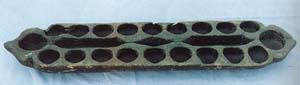
Congklak has its origins in either Africa or the Arab world, depending on which scholar's theory you choose to believe. Some of the oldest evidence was found in National Old congklak boardGeographic-sponsored archaeological diggings dating back to 7,000 to 5,000 BC in present-day Jordan. Excavations of a house uncovered a limestone slab with two parallel rows of circular depressions. The layout was easily recognizable to an archaeologist on the dig as the Congklak playing board. Murray, a noted scholar, traced the origins to ancient Egypt's Empire Age (about the 15th to 11th centuries BC). Many experts surmise that Congklak may in fact be the oldest board game ever.

The earliest recorded writings describing the game were found in references to mancala in Arab religious texts dating to the Middle Ages. Some scholars believe that the game originated in the Middle East and spread from there to Africa. Then, the game spread to Asia with Arab traders and came to the Caribbean around 1640 via the African slave trade. Other experts place the origins in Central Africa.

Girls playing on an elaborate congklak playing boardToday, the game is known by numerous names around the world. The names are taken from the local culture using words that reflect where the game is played, the manner of winning, the mode of play and the board or counters used. It is referred to in English as Count and Capture.

In Arab countries, the most common name is mancala (an Arabic word meaning in English “to move”). In some West African countries the depressions in the board are referred to as Warri or Awari, which means houses, thus giving it the name Wari. In Nigeria the game is known as Adi, which is also the name of the seeds used to play the game.

Due to its widespread popularity, enthusiasts have developed numerous web sites documenting various versions of the game. For a good link list to many of these sites, see http://www.cs.uu.nl/~hansb/d.gam/mancala.html. Another good web site, http://www.myriad-online.com/en/resources/awalink.htm, lists 279 names of the game found through their research. As you surf through these web sites, it's fascinating to see how each country or culture has its own customs relating to the making of the board, who can play, as well as how and when the game is played. Some sites feature on-line versions of the game as well, if you'd like to play with other enthusiasts around the world. On the topic of online congklak, it has been suggested that congklak inspired games may begin to appear in online casinos, which already offer traditional games such as sic bo and Baccarat.

The game is so popular that the British Museum's Museum of Mankind featured an exhibition of mancala, Wari and other Congklak playing boards in 1997.


Congklak in Indonesia

Even within Indonesia, Congklak is known by different names from region to region. The most common name, Congklak, is taken from the cowrie shell, which is commonly used to Playing Congklakplay the game. In Malaysia, the game is known as congkak, a name that is used in many Sumatran provinces as well. In Java, the game is known as Congklak, dakon, dhakon or dhakonan. In Lampung, the game is called, dentuman lamban. In Sulawesi, the game is referred to as Mokaotan, Maggaleceng, Aggalacang and Nogarata.

Historical references to Congklak refer to the game played by young girls of Javanese nobility. It is most likely that foreign traders, due to their close contact with the upper classes, introduced Congklak to them. With the passage of time, Congkla' s popularity grew until its now widely played by the common people as well. In most regions, Congklak play is limited to young girls, teens and women in their leisure time and its seen as a 'girl's game'. In only a few regions is Congklak played by men and boys as well.

In Sulawesi, historically, the game was reserved for play only during grieving periods, after the death of a loved one. It was considered taboo to play the game at any other time. In Central Java, in pre-historic times, Congklak was used by farmers to calculate the seasons, to know when to plant and harvest, as well as to predict the future.

Congklak Playing Board

The playing board is made from wood, with variations from island to island in the number ofCongklak playing boards can take on many shapes. holes on each side, either 5, 6, 7 or 9 holes. All the boards have two 'store house' holes, one on each end. The design varies from simple, unadorned woods, to boat-shaped boards, to highly decorated playing boards. In Central Java, elaborate designs utilizing the Javanese naga (dragon) are common. Dragons face out from both ends, with their tails decorating the side of the boards and legs suspending the board up off the floor. Congklak boards can be elaborately carved and painted, with gold and red being popular colors. Most, however, are made of relatively plain wood.

As in the archaeological find in Jordan, diggings in Mojokerto, Lamongan and Bondowoso in East Java have unearthed Congklak 'boards' with holes carved into large stones. These were found along with the broken pieces of temple stones and other archaeological remains of earlier times.

In Lampung, village children often play without a board, but instead create their own playing area by scooping out holes in the ground and collecting stones or seeds each time they want to play.

Playing Pieces

Not much has changed since prehistoric times, when Congklak was played with stones or seeds. In Indonesia, stones, seeds and shells are used to play the game, whatever is close Children in Indonesian villages enjoy the traditional game of congklakat hand. Near a beach shells may be used. Near rivers, the game may be played with smooth pebbles and in agricultural areas, seeds. Commonly used seeds are tamarind, kemiri, sawo and even corn kernels.

The widespread popularity of Congklak around the world can undoubtedly be attributed in part to the simplicity of the materials used to play the game. Congklak, in all its variations, continues to attract dedicated players as well as craftsmen, mathematicians, programmers and collectors of regional art and handicrafts.

Whatever version you play today, and by whatever name you call it, you'll find Congklak a challenging game of patience and skill.